


Back to all posts
Acquire
The European Software Paradox: Big Market, Small Scale
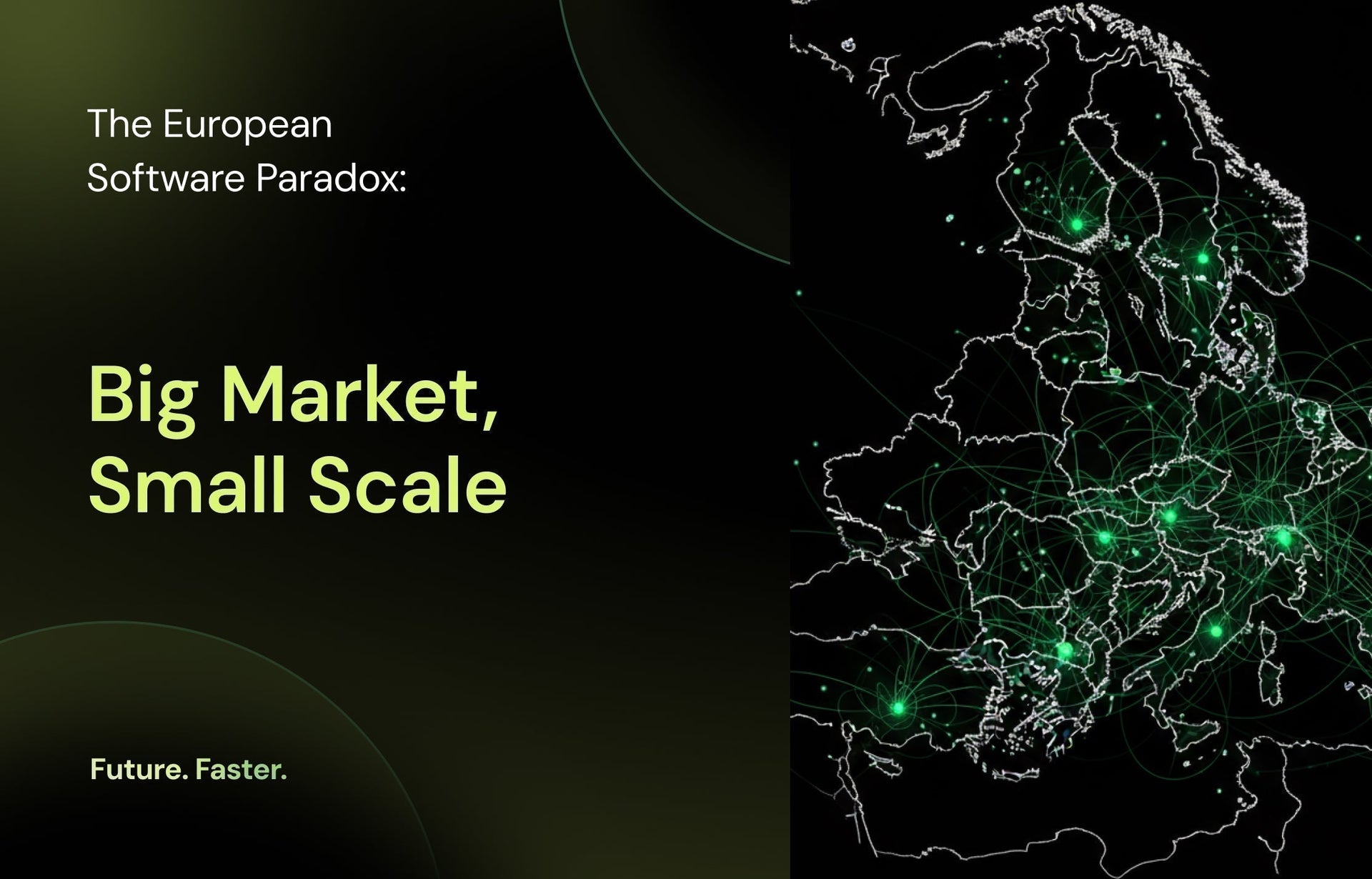
Shop Circle’s new report, The European Software Paradox: Big Market, Small Scale, explores why this happens and how AI-powered consolidation can unlock Europe’s full potential.
2 minutes, 53 seconds


By Shop Circle
Published
Updated
Europe builds some of the best software in the world, but rarely scales it. European founders lead in innovation but lag in global expansion.
Across the continent, over 50,000 software companies generate more than $2 million in ARR, and around 13,000 exceed $10 million. Yet only 15–20 have reached a true global scale. Roughly half are decades-old incumbents, while the rest are buy-and-build success stories. Europe’s software economy is vibrant but fragmented, a market full of promise that consistently falls short of producing global champions.
When venture capital isn’t enough
Fewer than 1% of VC-backed software firms in Europe reach $100 million in ARR, and almost none exceed the $400–500 million threshold required for large-scale IPOs. This makes it hard for most funds to return capital to their LPs.
At the same time, venture funding has dropped sharply, from a record $117 billion in 2021 to just $51 billion in 2024, or $25 billion when excluding AI mega-rounds, a decline of nearly 80%.

The rise of Europe's bootstrapped founders
Within this fragmented market lies a hidden strength: a generation of bootstrapped founders who have learned to grow sustainably. What began as a constraint has become a competitive advantage.
They focus relentlessly on revenue, customer needs, and operational efficiency. Their learner structures allow agility, while their clean financials and rational valuations make them attractive to acquirers. Yet even the best of them often hit a scale ceiling, limited by market size, talent access, or capital depth.
Smaller and mid-sized SaaS firms in Europe average €140k - €150k ARR per employee, while scaled peers reach ~€230k, thanks to shared infrastructure and broader go-to-market reach.
The fragmentation trap
Europe’s software landscape is fractured by design.
27 jurisdictions, 24 languages, and the absence of a unified digital market make cross-border scaling costly and slow. Different tax systems, compliance frameworks, and data privacy laws (from GDPR to local standards) create even more friction.
Despite these challenges, long-term demand remains strong. European IT
spending is projected to reach $1.28 trillion in 2025, up 8.7% from 2024.

From fragmentation to platforms
On average, European SaaS margins hover around 9%, compared to 35% for scaled companies within Shop Circle’s portfolio, proof that AI-driven leverage, shared infrastructure, and talent density can transform profitability.

By bringing profitable, founder-led companies together under one AI-powered platform, it is possible to spread R&D costs, centralise support, and unlock superior unit economics.
Consolidation is not defensive, it is a catalyst for profitable, compounding growth.
The path forward
Europe does not lack ideas, talent, or customers. It lacks the infrastructure to scale them.
AI will change that. As automation and intelligence weave into every function, from customer support to product development, the cost of scale is collapsing.
At Shop Circle, we see this shift as one of the greatest value creation opportunities in modern software, transforming independent, profitable companies into global category leaders through shared AI infrastructure.
Discover:
- Why organic scale remains rare in Europe
- How AI-driven platforms are reshaping SaaS economics
- What it takes to build Europe’s next generation of software leaders


